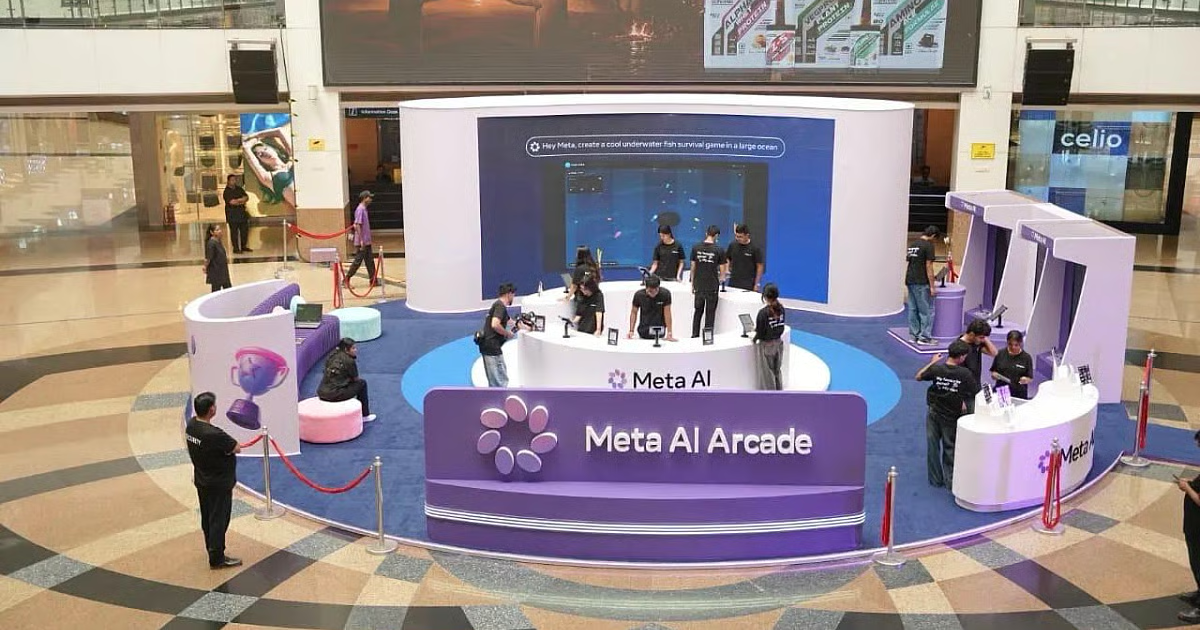
The three day experience was held at Infiniti Mall in Malad from September 11 to 13 as part of Meta’s “Create & Play with Meta AI” campaign. The activation was designed around a simple concept: give people an idea, let Meta AI handle much of the creation process, and see what kind of game comes out of it.
Also read Rohit Sharma Joins LightFury Games as Investor Ahead of eCricket Launch
Rather than presenting AI as something that only belongs in a developer’s toolkit, Meta is trying to make game creation feel much more approachable. Visitors at the Mumbai event could start with a basic prompt and turn that idea into an interactive experience, giving people with little or no traditional game-development experience a chance to see what is possible.
The arcade itself featured a mix of puzzle, racing and classic arcade-style games, including creations from an online game-building challenge. That gave visitors something to play while also showing how different people were using AI to turn their ideas into games.
There was also a strong creator angle to the event. Gaming and digital creators including Payal Gaming, Sarthak Sachdeva, funcho, Vanshaj Singh, and Divesh & Vishakha were involved, alongside winners from the online challenge. Their participation helped make the event feel less like a traditional technology showcase and more like a community-driven gaming experience.
Meta also brought some real-world ideas into the experiment by working with FlixBus, Uber India and Comet. Instead of simply putting company logos around the arcade, the brands were used as inspiration for custom game concepts based on everyday situations. The ideas included things such as managing a busy workday, planning a commute and delivering a package.
That part of the experiment is particularly interesting because it shows how Meta sees AI game creation working beyond traditional gaming communities. A person doesn’t necessarily need to start with a detailed game design document. They can begin with something familiar and see how an AI tool turns that concept into something interactive.
For gamers though there is an obvious question: how far can this actually go?
Creating a small puzzle or arcade experience from a prompt is very different from making a full-scale game. Modern games can require complex gameplay systems, animations, sound design, networking, performance optimisation and months or even years of development. AI can potentially speed up parts of that process, but it doesn’t suddenly remove all of those challenges.
That’s what makes Meta’s experiment interesting rather than simply another AI demonstration. The company is testing whether ordinary users can become more involved in the creative side of gaming, rather than leaving game creation entirely to professional developers.
The campaign also reflects a wider shift happening across the gaming industry. AI is increasingly being explored for everything from development and asset creation to NPC behaviour and procedural content. Meta’s approach is different in that it puts the creation process directly in the hands of the user.
For India’s gaming and creator community, that could be particularly relevant. The country has a huge audience of gamers and content creators, but not everyone who has a game idea has the technical skills or resources to actually build it. Tools that reduce that initial barrier could give more people an opportunity to experiment.
The Mumbai Gaming Arcade has now wrapped up, but the bigger experiment is likely to continue through Meta AI itself. The company says the campaign was built around showing how a simple prompt can become an interactive game, suggesting that the physical event was more of a demonstration of what the technology can do than a one-off gaming attraction.
Whether AI-created games eventually become genuinely competitive with traditionally developed games is still a much bigger question. For now, Meta is showing that the gap between having an idea for a game and actually making a playable version of it could become smaller.
And honestly, that’s probably the most interesting part of this whole experiment. The next generation of game creators may not always begin with a game engine or a programming tutorial. Some might simply begin with a prompt.